WELCOME TO HUMANE IN THE MEMBRANE, LLC!

When the Same Challenge Keeps Returning: What Is Your Organization Trying to Teach You?
In all my years doing this work, I have heard some version of this more times than I can count.
You are a leader—or you are leading a team—and something inside the organization is not working. So you call me. We talk. I ask you to tell me what the problem is.
And almost every time, the thing you are describing is not actually the thing that is wrong.
So I ask a different question: “How long has this been going on?”
That is when I hear it.
“We’ve tried fixing this—I do not even know—three times? Four?” And it keeps coming back.
Three. Four. Ten, if we are being honest. The number changes. The pattern does not.
This is the first in a three-part series about what to examine when a challenge keeps repeating: learning, leadership, and systems. We begin with learning—not training, not a workshop, but what an organization is actually able to notice, hear, and adapt before a pattern becomes a crisis.
The Question Everyone Reaches For
When something keeps happening—the initiative stalls, the team seems misaligned, the follow-through never sticks—the first question almost everyone reaches for is: Who failed to execute?
I understand why. It's quick. It releases pressure. It assigns someone or something as the problem, which can feel like progress because now there is something to point to. Somewhere to put your frustration.
But let me say this plainly: it is usually the wrong question.
The deeper, more humane question—the one I actually ask—is:
What conditions are making this outcome predictable?
What is the pattern trying to teach you?
That is a harder question to sit with. It doesn't give you an easy answer. It doesn't hand you a person or a department to blame. It asks you to look at the environment and the conditions you have built, not only the people standing in it.
Repetition is not proof of resistance. It isn't proof that someone is incompetent or that nobody cares enough to fix the problem.
Sometimes, it is a signal that you are trying to deliver a new outcome using conditions built for an old one.
From Failure to Feedback
In many of the organizations and teams I work with, I notice something before we even arrive at the visible problem: nothing has changed in a long time.
No new process. No new thinking. No space to reconsider what is no longer working. Things have simply gone stale.
When I name that out loud, it is often interpreted as resistance. People assume their teams do not want to change or do not care enough to try.
But a missed deadline, a disengaged team, a stalled initiative, or persistent conflict is not the whole problem. It's evidence.
It's evidence that something in how the organization learns, leads, or operates needs attention.
Evidence only helps if you know where to look. Most people look in one place: the most visible place. That's why the same fix gets applied, and the same problem keeps coming back.
The answer is not always a bigger fix.
Sometimes, it is looking somewhere you have not looked yet.
Look Beneath The Surface
I think of recurring challenges like the ocean.
What you can see at the surface is real: the missed deadline, stalled initiative, strained partnership, or disengaged team. It is the issue that prompts the meeting and demands attention.
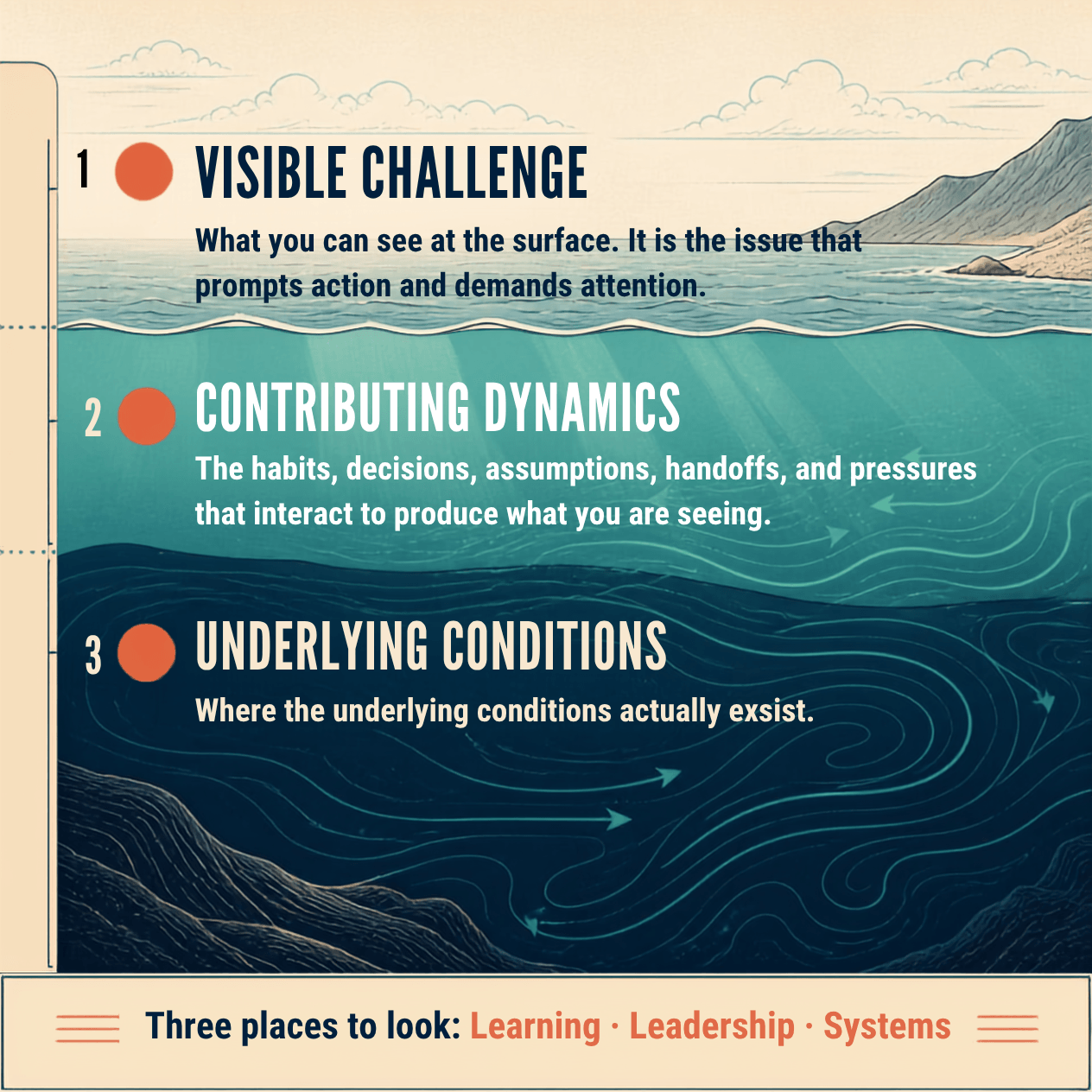
Just beneath the surface are the contributing dynamics: the habits, decisions, assumptions, handoffs, and pressures that interact to produce what you are seeing. This is where many fixes land. They may interrupt the pattern for a while, but they do not necessarily change what produces it.
Deeper still is the current: the underlying conditions that make the outcome predictable in the first place.
That is where a durable response begins—not by blaming the people doing the work, but by examining what the organization is teaching, rewarding, making possible, or making difficult.
The root-cause distinction is useful here. Contributing factors explain how an outcome happened; root causes point to the deeper why behind the conditions that allowed it to happen. The CDC uses this distinction in food-safety investigations; the same diagnostic discipline can help leaders look beyond a visible organizational challenge to the conditions making it predictable. CDC: Root Causes of Outbreaks
A cause-and-effect, or fishbone, diagram can help teams map multiple possible causes rather than prematurely settling on one explanation. (ASQ: Quality Tools & Templates)
Most leaders and organizations get stuck at the surface because the surface is loud. The current takes longer to find.
That is where these three patterns come in.
Three Patterns To Notice
While the current presents differently in every organization and team, in my work I've notice three distinct patterns that let me know they are stuck on repeat. You'll probably recognize at least one of them.
The Surface Fix. Something looks solvable—quick, obvious, right there in front of you—so you act on it. I get it. The surface answer can feel complete. And that feeling of completion is exactly what stops us from checking whether it actually is. A team misses a deadline, so leaders add a status meeting. A project stalls, so they create another tracker. Communication breaks down, so they send a longer email. Those actions may be useful. But before deciding they are the solution, ask:
What keeps making this issue necessary in the first place?
The Person-First Explanation
“Staff are not executing.”
“They do not get it.”
“They need more accountability.”
“They need more training.”
That's often where the conversation stops. It's the first plausible explanation, and it usually lands on a person. But go one layer deeper, and what I often find is more structural than personal: a process isn't clearly built. Decisions and responsibilities aren't clarified. Clarity around what growth, collaboration, or success is supposed to look like in practice never happens. People were handed an expectation, without clarity of the path. A problem that looks like poor accountability may actually be a clarity problem, a capacity problem, a decision-rights problem, or a leadership-support problem.
The More Cycle. More meetings. More resources. More time on the calendar. More reporting. More training. More tools. You keep adding because adding feels like doing something. Meanwhile, everyone—you included—is running on empty, and nobody can quite name what would make the wheel stop.
Sometimes organizations genuinely do need more resources, time, staffing, or tools. Mission-driven work is often under-resourced, and pretending otherwise does not help anyone. But before adding more, ask whether the organization has made clear choices about priorities, capacity, decision rights, and what work can stop. More capacity only helps when it is connected to a clearer way of working.
The same question sits beneath all three patterns:
Are you solving the thing that is actually there—or the thing that is easiest to point to?
Three Places To Look
Root-cause diagnosis is not only about going deeper. It is also about widening the view.
When a pattern keeps repeating, I look through three connected lenses: learning, leadership, and systems.
These are not separate boxes to check.
A learning gap may be shaped by unclear leadership. A leadership challenge may be reinforced by a system that rewards the wrong behavior. A systems problem may remain invisible because people do not feel safe naming what they see.
The causation runs in both directions, and it does not announce itself.
Sometimes you start with a specific team or breakdown and move outward, asking how it connects to the whole. Other times, you begin with a pattern across the organization and move inward, asking which specific part is driving it.
Neither direction is more correct. What matters is that you move.
Stay only with the part, and you may misdiagnose the size of the problem. Stay only with the whole, and you may never find where to intervene.
In this post, we begin with learning: what the organization is able to notice, hear, and adapt before a challenge becomes a crisis.
Learning: What Can Your Organization Notice and Adapt?
When people hear “learning,” they often think training: a workshop, a session, something formalized and scheduled.
And there is a place for that.
But you cannot fix what you do not notice. Most organizations have built plenty of ways to train people. Very few have built reliable ways to notice what is happening while it is happening.
That is the learning gap I mean here.
Not whether people attended training, but whether the organization has a real way of finding out what is true before it becomes a crisis.
Consider a nonprofit that rolls out a new approach to service delivery. It's reasonable on paper and launched with genuine energy. Within weeks, the people doing the work can see that something is not quite right. It's not necessarily broken, but it does't match how the work unfolds day to day.
Nobody asks them. Nothing in the organization’s routines makes it easy to say so.
Leadership doesn't find out for two more months—not because the people closest to the work did not notice, but because noticing something and being able to say it are two different things.
By the time the concern reaches leadership, it's no longer a small adjustment. It's an approach nobody trusts and everyone is already quietly working around.
The team was not resisting the new approach. Nobody was uninformed.
The organization simply was not built to hear what its own people already knew.
What Changes When Learning Is Possible
The shift is not necessarily a new process to install.
It is a posture.
It's treating the moment when someone says, “This isn't working,” as useful information—not as a problem to manage, a complaint to minimize, or evidence that someone is not on board.
It's creating conditions where people closest to the work trust that naming a problem will move something instead of costing them something.
That doesn't mean every concern requires an immediate solution. It means people can see a pathway from observation to conversation, from conversation to learning, and from learning to adjustment.
When people cannot safely surface what they see, organizations lose critical information. Leaders are left making decisions with partial data, while the people closest to the work develop quiet workarounds just to keep things moving.
That's not a people problem – it's an organizational-learning problem.
Where I Would Start
Where I would not begin is by assuming you already know what your organization notices.
Ask.
Not with a survey. Not with a training. Not with another meeting designed to explain the plan.
Start with one question:
What are we learning from this pattern instead of simply reacting to it?
Ask it honestly. Listen without defending, explaining, or rushing to solve the issue. Notice what people say—and what they hesitate to say. Both are information.
From there, deeper diagnosis can reveal what the organization is missing, what it is not yet hearing, and which conditions are making the pattern predictable.
The Five Whys can also be a helpful follow-up practice. Ask successive “why” questions to move beyond the first explanation of a problem. It works best when each answer is tested with evidence and informed by the perspectives of people who experience the work firsthand. The Institute for Healthcare Improvement describes the technique as asking “why” repeatedly to help identify an underlying cause. (IHI’s 5 Whys: Finding the Root Cause)
Sit with what you hear before you fix anything.
These are not just leadership questions. Any staff member can ask them within their own team. A mid-level manager can ask them in their own context without waiting for permission from the top.
The fix that follows a real answer works differently than the fix that follows a guess.
Try This
Choose one recurring challenge. Then ask your team:
What are we learning from this pattern instead of simply reacting to it?
Listen without defending, explaining, or trying to solve it immediately.
Notice what people say. Notice what they hesitate to say.
Both are information.
You don't have to solve the whole ocean today. You just have to stop mistaking the wave for the water.
Where This Question Takes You
Once you stop asking who failed, you are left with a more useful question:
What conditions made this outcome predictable?
The answer may begin with learning, but it rarely ends there.
It will likely lead you into leadership: what has been made clear, possible, and safe.
It will lead you into systems: what is rewarded, reinforced, or made unnecessarily difficult.
Every layer you are willing to examine changes what becomes possible to fix.
That's the real implication. Not one perfect solution.
A different way of seeing the organization altogether.
Leadership and systems are their own versions of this same question. We'll get there.
For now, start with what your organization is able to notice, hear, and learn from—before the same challenge has to come back again.
Lead with heart. 💛
Want a place to begin?
Download the Root Cause Field Guide: The Learning Lens—a practical reflection tool to help you recognize recurring patterns, examine what your organization may not be noticing, and identify where to look before applying another fix.
Let us know what you think in the comments below!
Join our Humane Blueprint Community Blog Page!
YOU MIGHT ALSO LIKE

Christina Jones, M.Ed.,Ed.S.
Thank You for Being Here!
Every transformation starts with a single step — and I'm honored you're considering yours with me. Follow along, stay connected, and let's keep building toward what's possible, together.
Where strategy meets heart. 💛




Inspiration in your Inbox!
Get resources, tips, and updates to support your growth in leadership, learning, and systems.
Free Monthly
Newsletter
© 2026 Humane in the Membrane, LLC. All Rights Reserved.